
How Weekly Engine helps identify the Cycle Bottom
DECISION TERMINAL v.1.8

A live case study: the end of the 2021-2023 bear market
Weekly Engine answers one simple question:
What should you do this week - buy, buy the dip, hold, or wait?
Most importantly, the engine does not try to guess the exact bottom price. No one can point to a single candle and say, “That is the low.” Weekly Engine helps identify the bottom step by step, through a sequence of signals. First an early sign appears, then confidence builds, then the reversal is confirmed.
In this post, we will look at how this worked in real time. We will take the end of the 2021-2023 bear market - that exact moment when, after the FTX collapse, price fell to $15,500 and then turned higher. Then we will go week by week and see what Weekly Engine was showing.
Why this matters
Catching the bottom manually is almost impossible. The bottom is always scary. The news is bad, price is falling, and everyone around you is saying, “It is going lower.” That is exactly when you need to buy, but it is also when it is psychologically hardest to do it.
Weekly Engine solves that problem. It does not say, “Buy everything right now at peak fear.” It says something else:
It looks like we are in the late phase of a bear market. Start buying carefully, with no more than 60% position size. The bottom is not confirmed yet, but the accumulation window is already open.
So you are not entering the market with one all-in bet, but gradually, under risk control. And when the reversal is finally confirmed, you already have a position. You did not miss the bottom, and you did not put everything into one risky entry point.
How to read the main Weekly Engine card
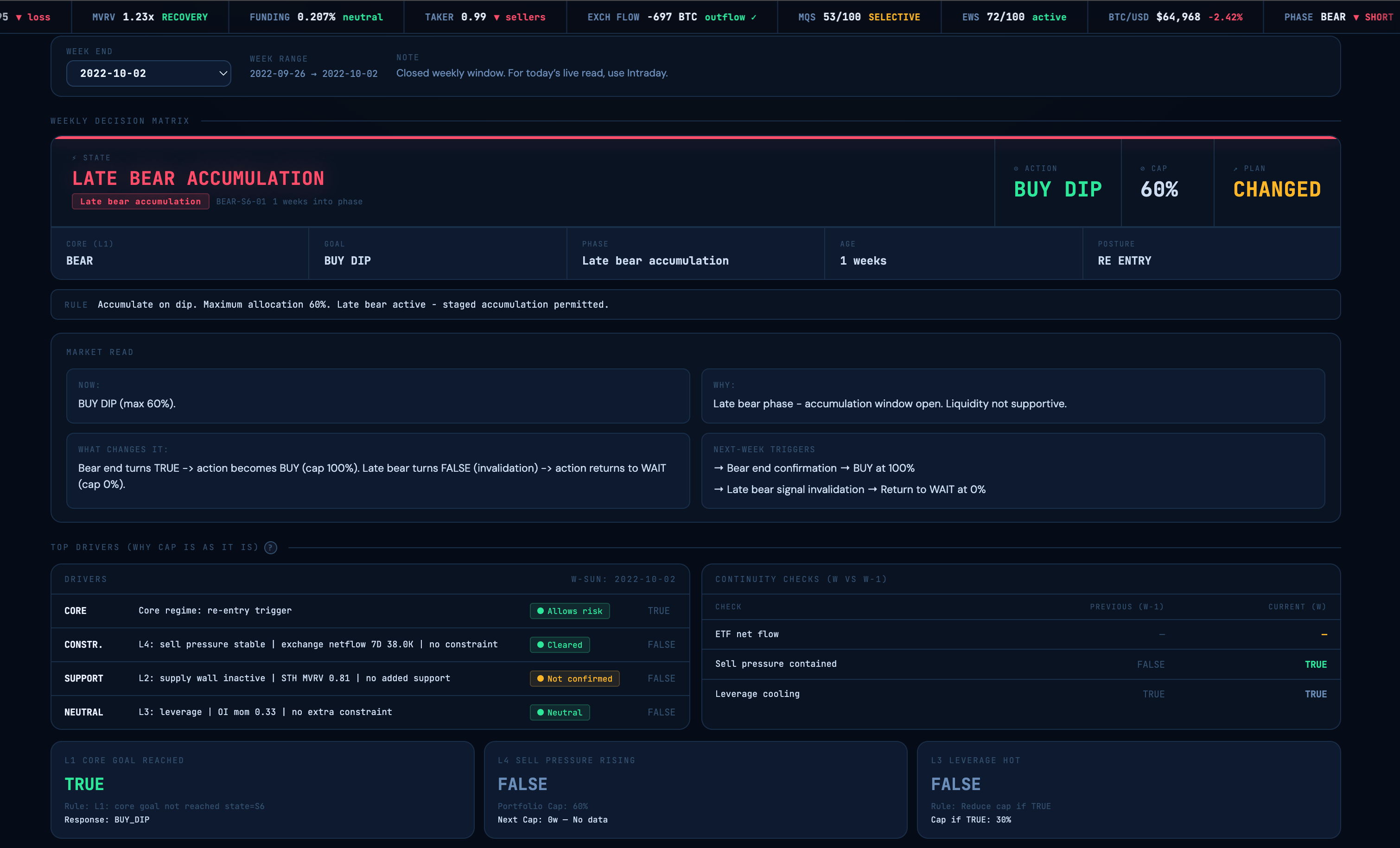
Every week, Weekly Engine gives you one card - the Weekly Decision Matrix. Let us go through its fields one by one.
STATE - the main label and the color of the card. This is the current regime. For example, LATE BEAR ACCUMULATION or BULL RE-ENTRY. Next to it, you see the phase code, for example BEAR-S6-01, and the number of weeks spent in that phase.
ACTION - what to do. BUY, BUY DIP, or HOLD.
CAP - the maximum position size. 60% means: keep buying, but do not go above 60% of full size. 100% means: you can build a full position.
PLAN - whether the plan changed versus the previous week. CHANGED or UNCHANGED. This is a useful marker: if it says CHANGED, the card deserves extra attention.
CORE (L1) - the base layer. This is the underlying regime: BEAR or BULL. It is the slowest and most important layer.
GOAL - the goal for the week. In practice, this is ACTION phrased in plain language.
PHASE - the detailed name of the phase inside the regime.
AGE - how many weeks the market has already spent in this phase. The longer it lasts, the more mature the setup becomes.
POSTURE - the current risk stance. For example, RE ENTRY, FULL RISK ON, RISK ON DIP, or RISK ON.
RULE - the operating rule in plain language. For example: “Buy the dip. Maximum allocation 60%.”
MARKET READ - a block with four parts:
NOW - what to do right now
WHY - why this is the right move
WHAT CHANGES IT - what needs to happen for the plan to change
NEXT-WEEK TRIGGERS - the specific triggers for next week
The last two parts are the logic of the engine. They show the conditions under which the system will switch into another regime. This is not a prediction, but a decision map: if A happens - we move into one scenario, if B happens - we move into another.
The sequence: how the engine moved into and through the bottom
Now for the most important part. Let us walk through five stages and see how Weekly Engine led into the bottom and then through it.
October 2, 2022 - the first signal
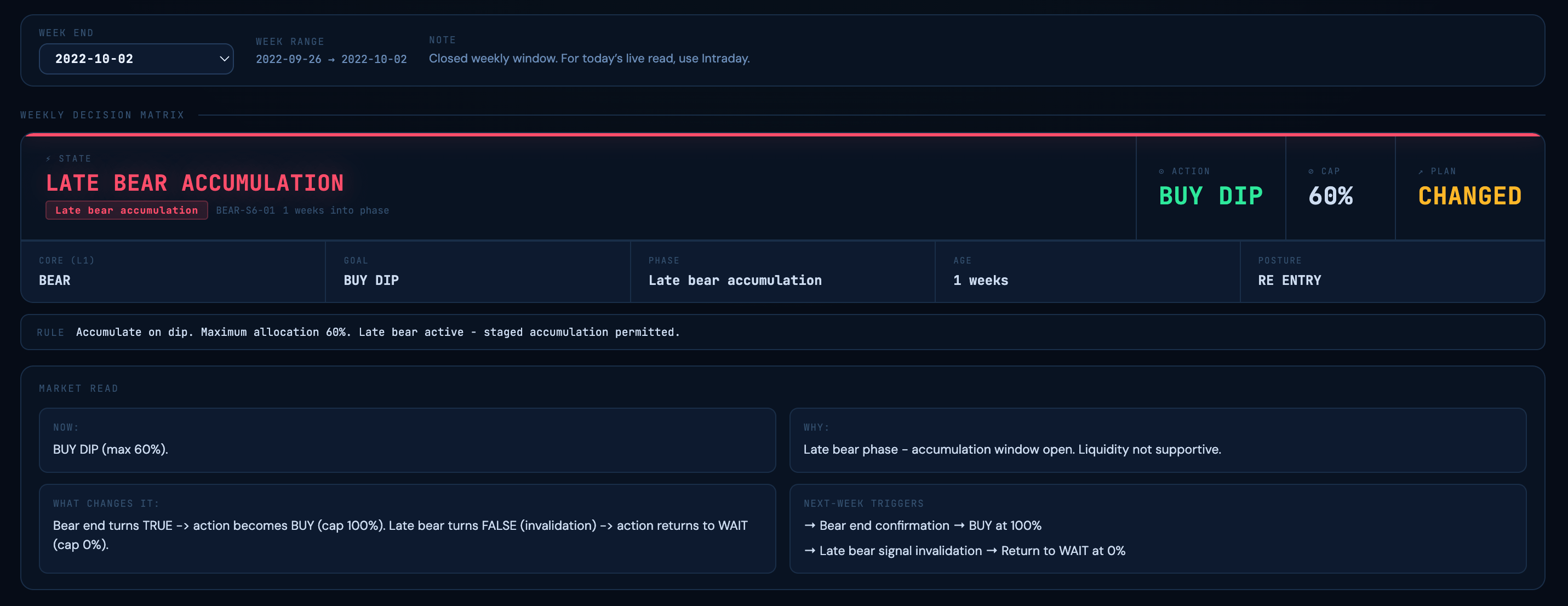
STATE: LATE BEAR ACCUMULATION · ACTION: BUY DIP · CAP: 60% · PLAN: CHANGED
This is the early signal. For the first time, the engine said: we have entered the late phase of the bear market, and the accumulation window is open. The phase code is BEAR-S6-01, week one. The posture is RE ENTRY, meaning a cautious re-entry.
The rule is simple: buy the dip, but do not go above 60% position size. The base layer is still BEAR, and the bottom is not confirmed. That is why the system deliberately limits risk.
What changes the plan: if the end of the bear market is confirmed, the action becomes BUY at 100%. If the late-bear signal is invalidated, the system goes back to WAIT and zero allocation.
The message here is simple: “It looks like we are close to the bottom. Start buying, but do it carefully and in small pieces. Do not go full size yet.”
November 27, 2022 - maximum readiness
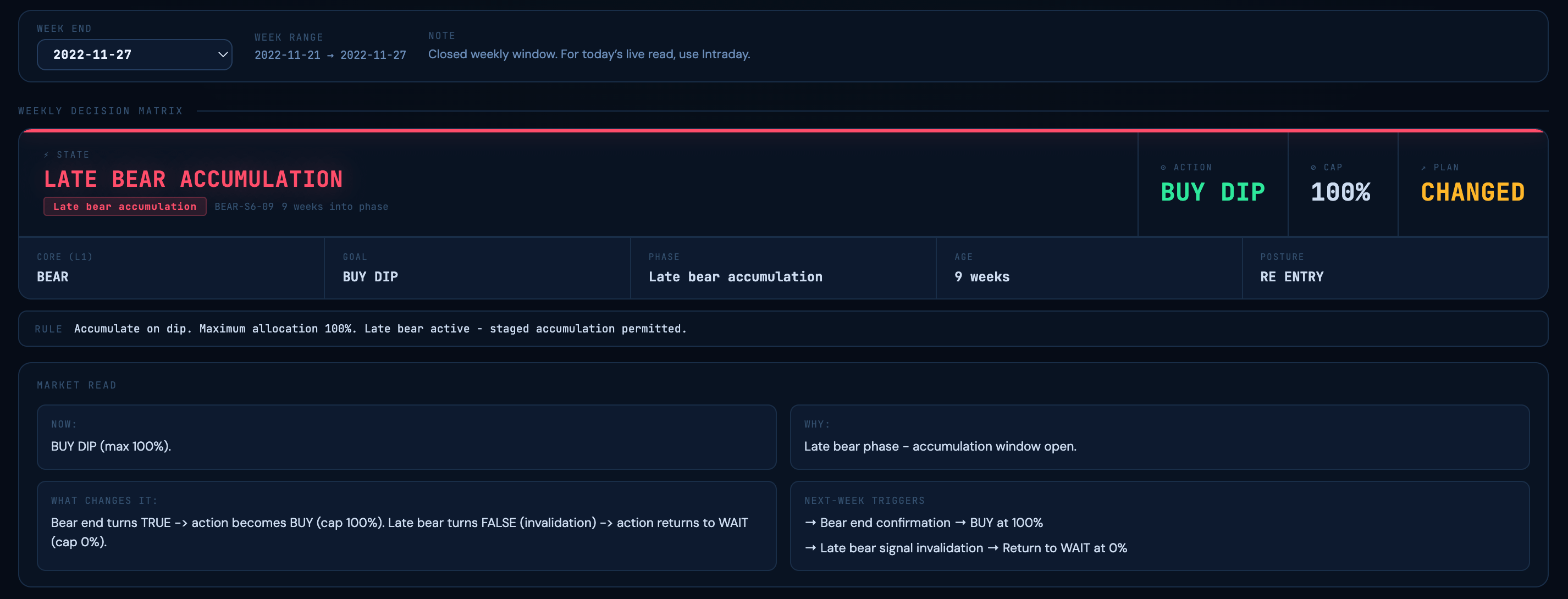
STATE: LATE BEAR ACCUMULATION · ACTION: BUY DIP · CAP: 100% · PLAN: CHANGED
Nine weeks have passed in this phase, BEAR-S6-09. During that time, the market lived through the FTX collapse and dropped to $15,500 - the ultimate low of the cycle. At peak fear, the engine did not panic. It did the opposite and raised the cap from 60% to 100%.
Notice this point carefully: the regime is still called LATE BEAR ACCUMULATION. The bottom is still not officially confirmed. But confidence in the accumulation zone has grown enough for the system to allow a full position.
That is the key lesson. Peak fear is not a reason to run - it is a point of action. This is exactly where Weekly Engine gives its maximum accumulation limit, even before the formal reversal confirmation.
In other words: “It is very painful and very cheap. This is the best buying zone. Buy it in full, even though the regime is still formally bearish.”
December 4, 2022 - the verdict: the reversal is confirmed
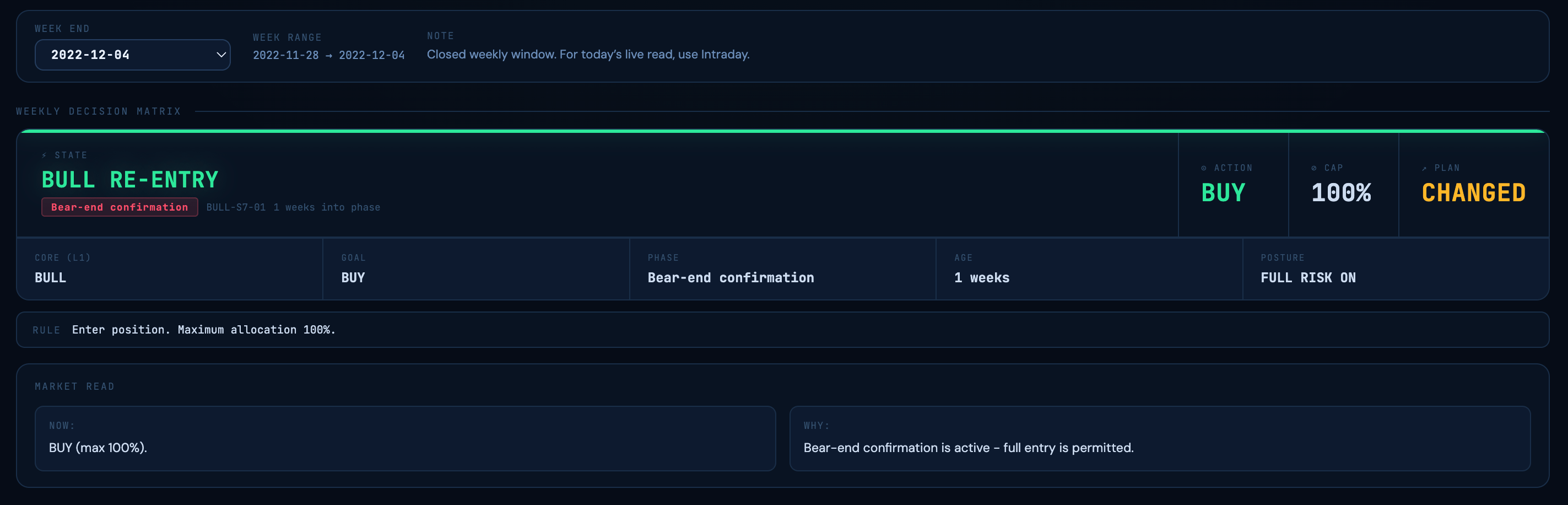
STATE: BULL RE-ENTRY · ACTION: BUY · CAP: 100% · PLAN: CHANGED
This is the main switch. The base layer changed from BEAR to BULL. The phase is Bear-end confirmation, code BULL-S7-01, week one. The posture is FULL RISK ON.
The action changed as well: no longer “buy the dip,” but simply BUY. The rule is short: take the position, maximum 100%.
This is the regime change. The bottom was not guessed from one candle - it was confirmed through the structure of signals. By this point, if you had been following the engine, your position had already been built from October through November. The December verdict simply confirmed that the trend had turned.
The meaning is straightforward: “The bear market is officially over. This is now a bull regime. Full entry is allowed.”
December 11, 2022 - the first pullback in the new bull cycle
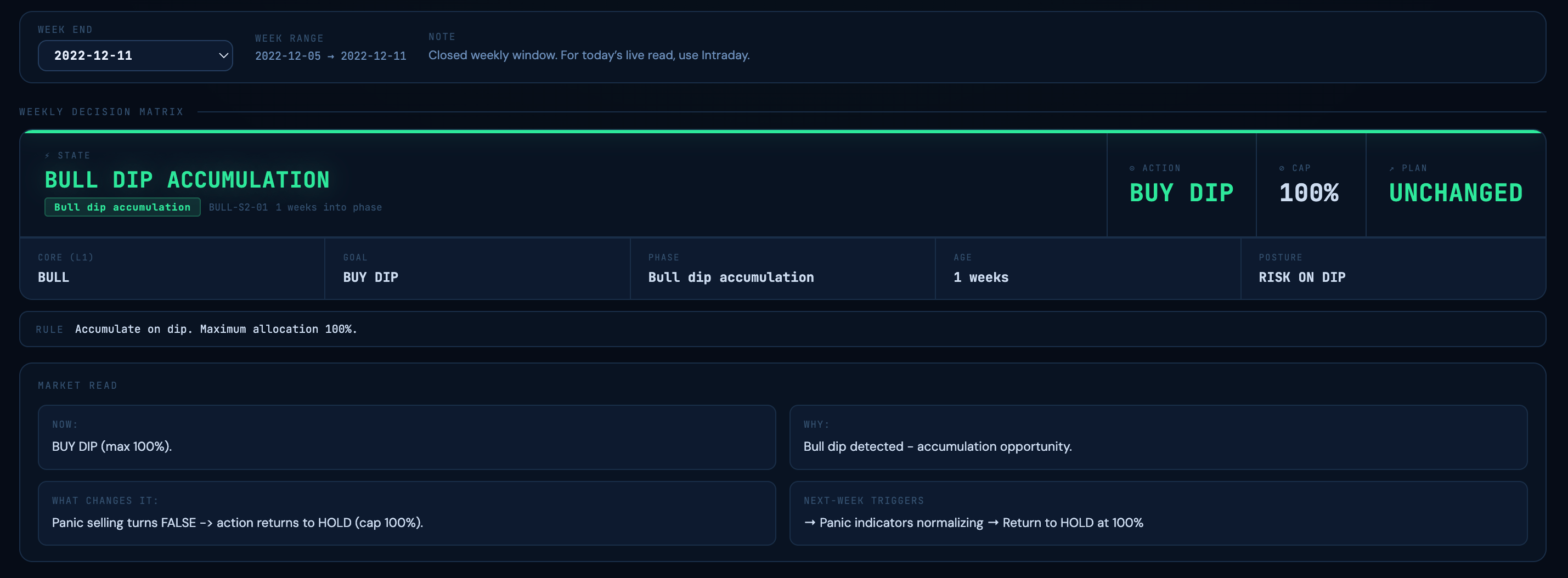
STATE: BULL DIP ACCUMULATION · ACTION: BUY DIP · CAP: 100% · PLAN: UNCHANGED
After the reversal was confirmed, the market pulled back slightly. The engine read that pullback as a chance to add inside the new bull regime. The phase is Bull dip accumulation, and the posture is RISK ON DIP.
What changes the plan: if the panic selling stops, the action returns to HOLD. So in this case, the pullback is a temporary window to add, not a reason to panic.
Put simply: “Price pulled back, but the market is already in a bull regime. This is not a fresh reversal lower - it is a discount. Buy the dip.”
January 15, 2023 - the final verdict: the market has settled
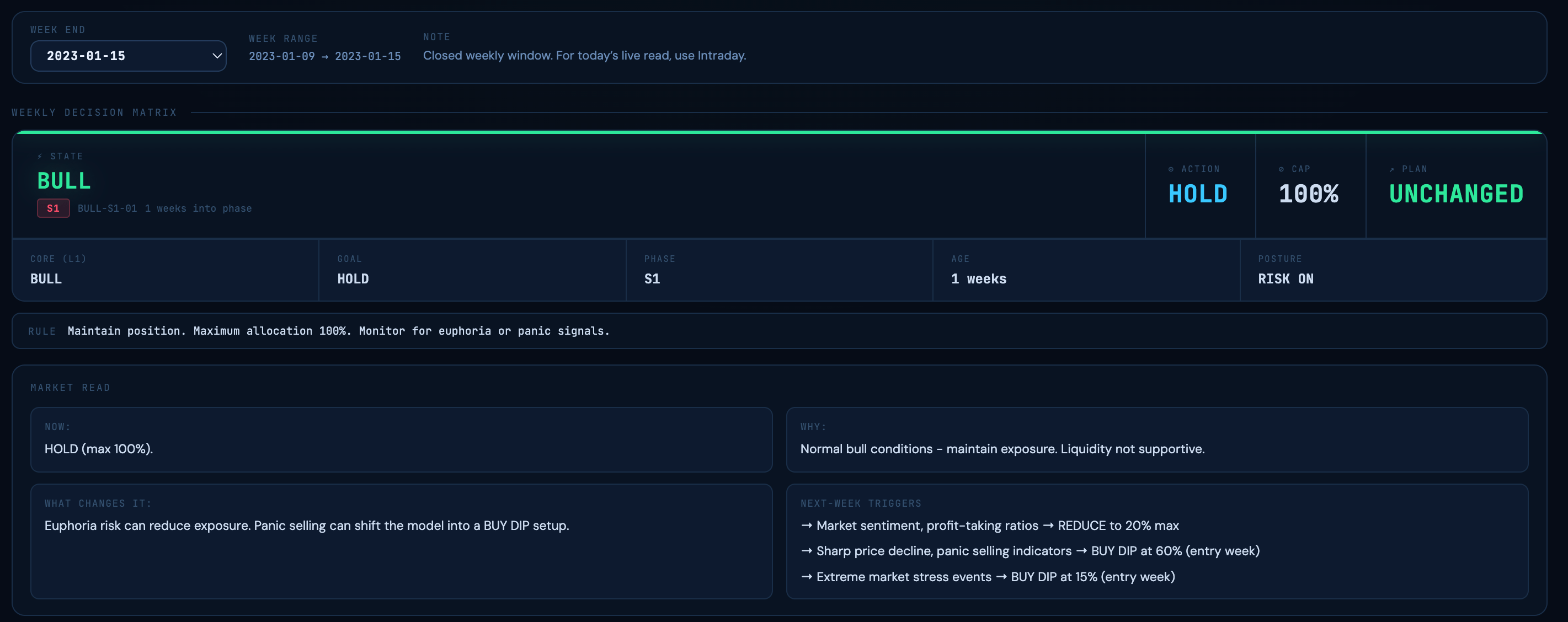
STATE: BULL · ACTION: HOLD · CAP: 100% · PLAN: UNCHANGED
At this point, the full picture had come together. The regime is simply BULL, phase S1, a normal bull phase, code BULL-S1-01. The posture is RISK ON. The action is HOLD: the position is already built, and now it just needs to be held.
The rule is: hold the position, maximum 100%, and watch for signals of euphoria or panic. No unnecessary movement - just normal bullish conditions.
This is the final outcome of the whole sequence. The bottom-identification process is complete. From the first cautious signal in October, through maximum accumulation during fear in November, and reversal confirmation in December, the system moved into calm position holding in a bull regime.
In the trigger block, the engine is already looking ahead at downside risks: if euphoria rises and profit-taking becomes aggressive - cut allocation to 20%; if the market drops hard and panic returns - get ready to buy again. The bottom is behind us, but the system still keeps fresh scenarios ready in case conditions change.
In other words: “The market has stabilized. We are in a bull regime, the position is built, and now it should be held. The bottom is already behind us.”
The main takeaway
Look at the whole sequence at a glance:
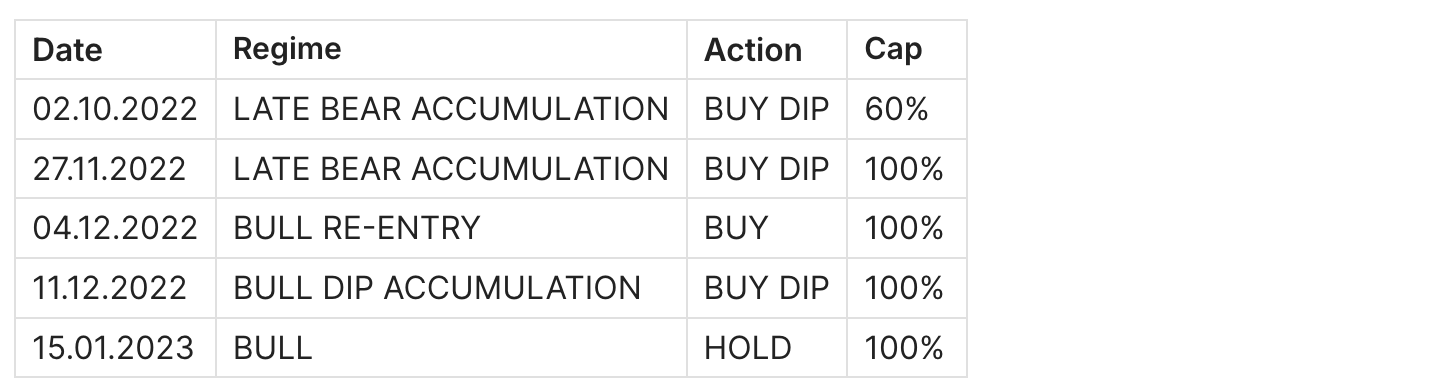
This is the essence of Weekly Engine:
1. The bottom is not identified as a single point, but as a staircase.
First an early signal appears with a small cap, then the cap grows, and only after that comes confirmation. You enter the market gradually, not with one all-in bet.
2. The scariest moment is often the actual signal to act.
After FTX, the engine raised the cap to 100%, even though the regime was still formally bearish. The system moves against the crowd, but it does so under risk control.
3. Confirmation comes later, and that is normal.
The official reversal, BULL RE-ENTRY, came in December, after the November low. By then, the position was already in place. The engine does not try to buy the exact bottom - it helps you buy in the bottom zone, and confirms it later.
4. The cap matters more than the headline.
You do not need to guess whether “this is the bottom or not.” You just need to follow the action, ACTION, and the cap, CAP, every week.
Frequently asked questions
What is the difference between LATE BEAR ACCUMULATION and BULL RE-ENTRY?
LATE BEAR ACCUMULATION is the regime where the market is close to the bottom, but the reversal is not confirmed yet. The system suggests building a position carefully. BULL RE-ENTRY is the confirmed reversal, where the base layer has switched to BULL and full entry is allowed. The first is preparation, the second is confirmation.
Why was the cap 100% at the bottom in November if the regime was still bearish?
Because the engine separates two things: the attractiveness of the accumulation zone and the formal confirmation of the reversal. At peak fear, the accumulation zone was strong enough for the system to allow a full cap. But the base layer moves more slowly and confirms the reversal only when the signals fully resolve into a new structure.
Why is there a BUY DIP phase inside the bull in December?
To distinguish a healthy pullback from a new reversal lower. After the bull regime is confirmed, the first pullback is a chance to add, not a panic signal. The engine says it directly: buy the dip, do not cut the position.
How often is Weekly Engine updated?
It is a weekly engine. It closes the week and gives a verdict on the completed week. For live reading during the week, the Intraday tab is used.
Questions - in the chat.
Keep reading with a 7-day free trial
Subscribe to Adler Insight 💎 Premium to keep reading this post and get 7 days of free access to the full post archives.